In one of the scenes in the middle, the female lead, who ends up in Korea and feels desolate there, listens to a Korean street musician playing the Ae Ajnabi track from the film Dil Se. Though the song is intensely poignant, it provides her with a sense of comfort. This scene, in a way, encapsulates the power of culture. Culture, embodied by language, music, arts, food, and so on. Made in Korea, a Tamil film now streaming on Netflix, pays tribute to the soft power called culture.
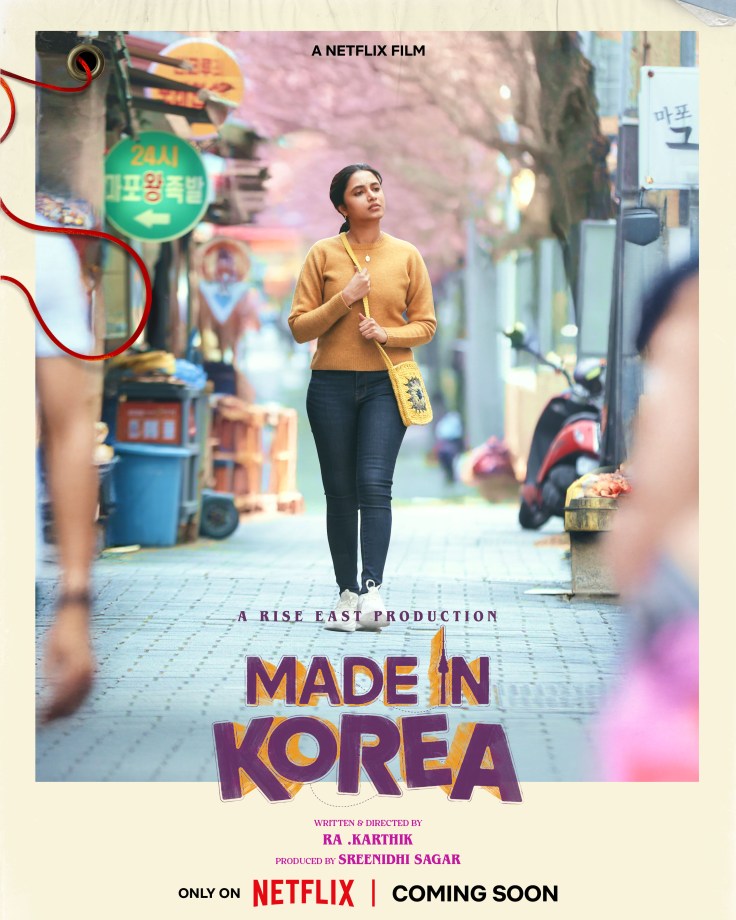
It all begins with a young girl in a distant, picturesque, hilly town in Tamil Nadu who dreams of travelling to Korea one day. Her dream has been shaped by some story about the connection between Tamil Nadu and Korean cultures, and later by the Korean pop (K-Pop) phenomenon that has captured the hearts of young girls worldwide. This is a place where internet connectivity itself is a challenge. We see a frame right at the beginning of the film in which the girl climbs onto an elephant to access mobile signals. These challenges and her family’s economic conditions don’t deter the girl from seriously pursuing the dream of visiting Korea someday.
The girl named Shenba indeed gets an opportunity to realise her dream of visiting Korea soon, but not under the pleasant circumstances she had hoped for. She ends up in Seoul as a stranger in a strange land. How she navigates her life from here and comes out in triumph is the rest of the film. Given the screenplay’s construction, it is not surprising that it reminds one of films like 47 Naatkal, Queen, or English Vinglish, which are all about women coming of age after their share of initial struggles abroad. What makes Made in Korea different is that it is, for the first time, a Tamil film set in Korea, and while the girl encounters some trouble in a faraway land, she is never shown to lack self-confidence.
And here lies the problem with the screenplay, too. Everything goes very smoothly for Shenba in Korea. The people she meets are all friendly and helpful. There is no obvious conflict or tension as she tries to find her footing in Korea. A love story between Shenba and her boyfriend plays out in the background, but from the start, it lacks depth. Therefore, the conclusion doesn’t feel impactful. Ra. Karthik, who has written the screenplay and directed the film, tries not to over clutter the film with too much drama or emotion. Almost all the key characters are shown from their own perspectives. What is it about K-Pop culture that sways young girls so much? I would have loved for the film to explore this angle from the beginning. It is also a missed opportunity not to show the downsides of K-Pop culture in Korea, such as exploitation, social pressures, and related mental health issues among the youth.
Priyanka Mohan plays the female lead and remains almost unperturbed by any challenge she faces. Even when she is sad or tense, she performs with a characteristic nonchalance, which I’m not sure is the brief or if she portrays it that way. To me, it certainly worked. The rest of the cast, including the Korean actors, has done a decent job.
Made in Korea is a feel-good film that can be watched with the family. But it lacks the tension necessary to elevate the screenplay and keep you engaged throughout. Beyond a point, it becomes predictable. There is no forced, mindless violence in the film, and Kamsahamnida (Thank you in Korean) to the director for that.
My Flash Verdict: Made in Korea is a good watch if you like coming-of-age, feel-good films, despite the predictability.
Post Credits: No
 AnandKumarRSonFilms
Leave a comment