What do the films Ela Veezha Poonchira, Kishkindha Kaandam, and Eko have in common? They are slow-burn Malayalam films in the mystery-thriller genre. They are also films in which the places and surroundings in which the film is set become characters in their own right, playing a significant role in the storytelling. Remove these places and set the film elsewhere, and the plot falls apart. Eko unfolds in a dense, hilly, forested landscape somewhere on the border of Kerala and Karnataka. As the film unfolds, the one thing that keeps coming to mind is how Bahul Ramesh, the writer, is able to conceive such stories with a non-conventional screenplay.
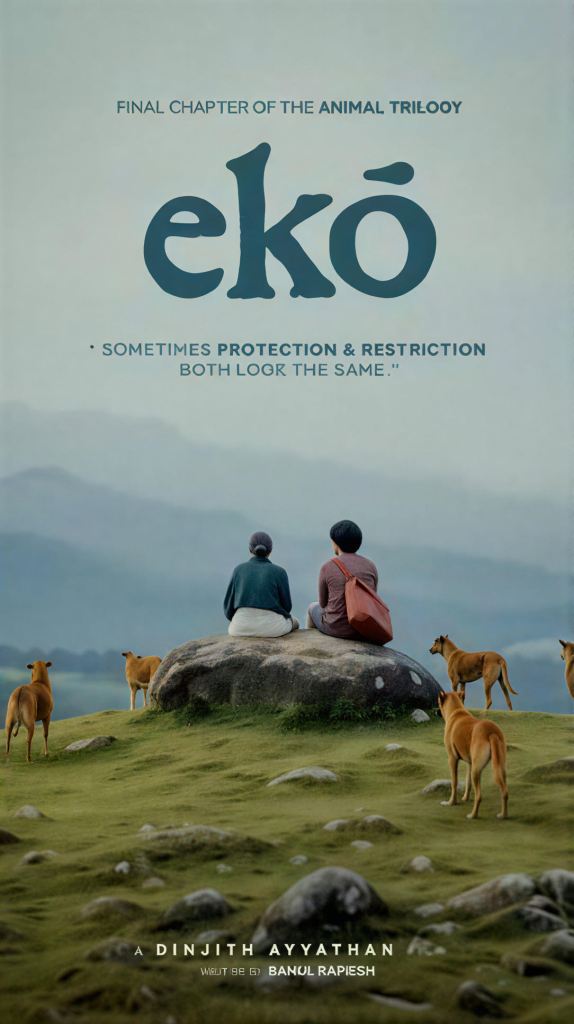
The film is written by Bahul Ramesh and directed by Dinjith Ayyathan, the same pair who created Kishkindha Kaandam (KK), one of the best films in the thriller genre. If monkeys were part of the subtext in KK, in Eko, a special breed of dogs is part of the narrative. At times, it seems the film is a documentary on dog breeding. The main character, Kuriachan, is a professional dog breeder. With the film’s tagline reading “Eko – From the infinite chronicles of Kuriachan, we infer that Kuriachan is a multifaceted personality, and the film probably deals with one aspect of his personality.
Throughout the film, various people come in search of Kuriachan, who has been missing for a few years. This includes the local police, a close friend, a Navy officer, and another man who becomes an important character. All of them have different backstories that add to the mystique of Kuriachan’s character. Is Kuriachan missing, dead, or underground? These are the questions the film tries to answer. In answering these questions, the non-linear screenplay keeps us in rapt attention, though the proceedings are designed for a slow pace.
This is a film that challenges the viewer’s intelligence. The screenplay doesn’t make many things obvious. It leaves a trail of sequences from the beginning, letting us connect the dots towards the end. In the last 10 minutes, when everything unravels, just as one of the characters is stunned, we are left dumbfounded for a while. The last act is a powerful frame. There is no action. There are no dialogues. There are no emotions displayed by the characters. Just a well-composed frame and an engaging background score.
You are not alone if you couldn’t understand how the climax played out on the first watch. And you are not alone if you went back to specific sequences to understand the connections. I certainly did, and therefore I could appreciate the brilliance of the writing. This is a film that requires repeat viewings to connect the dots. It is enough to say that the screenplay hides more than it reveals. This same aspect may disappoint a few viewers as well.
The film keeps playing out in your mind even after it ends. Even if the dots are connected, quite a few questions remain unanswered. Maybe they were deliberate, meant to keep us distracted. Why is Kuriachan being searched for by many? Is he nallavara (Good man) or kettavara (Bad man)? How did he amass so much wealth just by being a dog breeder? Why is the film titled Eko? Questions like these. And there are more around other characters as well, which, if I put out, will be spoilers.
What stands out in the film are the stunning landscapes and the top-notch camerawork. I wonder if the writer himself is also the cinematographer, like how Bahul Ramesh is in this film, takes a lot of the load off the Director’s shoulders. The film, shot in real locations with mostly natural light, is visually spectacular, to say the least, with the locales, whether in Kerala or Malaysia, adding to the mystique of the storytelling. The same applies to the fantastic background score of Mujeeb Majid.
The dogs play a crucial role in conveying the underlying emotions in a few scenes. Kudos to the team for training the dogs to deliver the intended performances that look real, not SFX/VFX. In particular, there is a scene in Malaysia that runs for more than five minutes, featuring a standoff between a bunch of dogs and Kuriachan, and it is brilliantly shot. There is also an action sequence in the midst of a forest that stands out for its rawness and camera work. In the same action scene, just by looking at the frame, we can tell that a third person (not in the frame) is watching the proceedings. I found this “POV cinematography” new for an action sequence. Ace Director K. Balachander often used this POV technique to capture the drama among the characters in a scene.
There are no big stars in the film, with Vineeth being the only known big name. Though the film revolves around Kuriachan, he is not the protagonist. There are a few protagonists, and interestingly, each has a character arc. It is commendable that the actors playing these parts understood this nuance and played accordingly. The Malaysian lady (Mlathi Chetatthi), played by Biana Momin, and her younger version, Soyi, played by Sim Fei, both stand out. Sandeep Pradeep as Piyoos is brilliant. I wonder why a Malayali actor was not chosen for the role of Kuriachan. I indeed found a native Malayali touch missing in Saurabh Sachdeva’s portrayal of this key character.
As I wondered what the film was essentially about, many aspects came to mind. It is about the human-dog relationship. It is about the loyalty of a servant towards his master. It is about friendship. It is about love and a husband-and-wife relationship. It is a revenge saga. Above all, it is about the ill effects of imposing restrictions in society under the guise of protection.
Eko is a brilliant film that has got the critical Cs of any cinema, namely Content, Craft, and Cast, bang on. I am not surprised it is regarded as one of the best Malayalam films of 2025. I would put it in the “Must Watch” category. Eko is now streaming on Netflix.
 AnandKumarRSonFilms
Leave a comment