(This piece was written for the news website thenewsminute.com and was first published on August 13, 2025, and can be read here:
For film buffs, August 15 this year marks an important milestone. It will be 50 years since Rajinikanth literally ‘gatecrashed’ the world of cinema in K Balachander’s Apoorva Raagangal. 50 years – let that sink in! For someone who didn’t tick any of the conventional boxes for a hero to remain the ‘Superstar’ of Indian cinema for so many decades is something out of a fantasy.
In another milestone, Rajini will turn 75 this December, and in an era where people talk about burning out by 40, here is a man who continues to raise the bar for expectations before a film release. We are just a few days from his next release – Coolie – around which there is a palpable buzz that only a Rajini film can generate.
In a career spanning over 170 films, Rajini’s continued presence among the top is truly remarkable. While there are many reasons for this, the purpose of this piece is to look at a few films that have been gamechangers in his career. These films have played a part in elevating him to where he is today, at the top of Tamil cinema, still commanding an unprecedented worldwide opening and a following that few of his contemporaries can match.
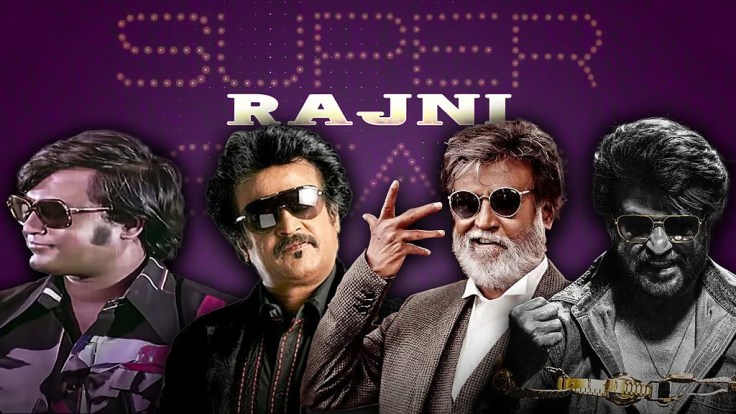
These seven films may or may not be Rajini’s most successful at the box-office. They also may or may not feature his best performances. But these films have – for different reasons – acted as crucial pivots in his filmography and proved to be turning points in his career. In short, these were gamechangers in their time.
Mullum Malarum (1978)
Directed by one of Tamil cinema’s most renowned directors, Mahendran, Mullum Malarum holds a significant place in Rajini’s filmography. It proved that Rajini was not solely about mannerisms and style, which was the dominant aspect of his acting until then, but also about performance. Mahendran, who brought a breath of fresh air to Tamil cinema with films rooted in realism by shunning the established template of formulaic films of the time, showed that Rajini could be a director’s actor.
The film earned Rajini his first popular award for acting when he received the Special Prize (Best Actor) at the Tamil Nadu State Film Awards that year. Of course, the bigger moment of glory came when his mentor and guru, Balachander, sent him a letter of appreciation for his performance in the film. His portrayal of Kali endeared him to the masses despite the character’s negative streak. Today, Mullum Malarum has achieved cult status in Rajini’s filmography.
Thillu Mullu (1981)
A remake of the iconic Hindi film, Gol Maal, Thillu Mullu went on to attain iconic status in Tamil as well. Rajini reprised the double role originally played by a brilliant Amol Palekar and surprised everyone with his performance. Thillu Mullu was the first film in which Rajini did a full-length comedy act, that too in a double role.
Even Rajini himself was unsure if he could pull off comedy, having previously played villain or serious protagonist roles. Also, for the first time, he had to shave off his moustache for one of the twin characters, which Rajini was reportedly hesitant about. It was only due to Balachander’s persistence in showcasing the actor in a new mould that Rajini finally agreed to play ball, and the rest is history. Thillu Mullu was a commercial hit, and Rajini’s comic act received critical acclaim, sowing the seeds for highlighting Rajini’s comedic talent in many of his later films.
As an aside, Thillu Mullu was Rajini’s last film with Balachander, as the director felt that Rajini was now a bigger star and he would find it difficult to make ‘his type’ of film with him. Kamal Haasan played a cameo in the movie, which is also the last Tamil film in which the Kamal–Rajini duo was cast.
Annamalai (1992)
By the 1980s, Rajini had become a big star in Tamil cinema and a bankable one at that, with a fair share of hits, but it was clear that he was plateauing. He also experimented with Hindi films during that period, though with limited success. It was then that he committed his dates to Annamalai in 1992 for Kavithalayaa, his guru Balachander’s production house.
Annamalai was director Suresh Krissna’s first collaboration with Rajini, and its massive success led to several other hits later in the star’s career. Looking back, with Annamalai, Krissna managed to create some notable firsts that would shape Rajini’s post-90s filmography.
Annamalai kickstarted the wave of Rajini films based on the now-familiar ‘riches to rags to riches’ template. It was also the first film to feature the signature ‘Super Star Rajni’ title card and the accompanying music. Additionally, it started the trend of single-word titles for Rajini films, which continues to this day. It started the trend of showing Rajini walking in slow motion with a group following him, the solo song with a motivational theme, a recurring punch dialogue, among others. Most importantly, Annamalai established Rajini as a mass star who could connect with an audience across all divides.
Chandramukhi (2005)
Chandramukhi came after a gap of nearly three years for Rajini. It followed Baba, which turned out to be one of the biggest flops in his career, especially in the post-Annamalai era, when he was riding high on successes like Veera, Baasha, Muthu, Arunachalam, Padayappa, and others. In my opinion, the failure of Baba prompted Rajini to press the reset button and explore new directions rather than sticking to the familiar ‘riches to rags to riches’ template.
Chandramukhi was a remake of the Kannada film Apta Mitra, which itself was a reimagining of the yesteryear Malayalam hit Manichitrathazhu. At the outset, the Manichitrathazhu plot lacked the typical ‘mass’ content often seen in Rajini films. Therefore, director P Vasu adapted it effectively to suit Rajini’s fan base, without many elements commonly associated with his previous films. Despite this, the film made records at the box-office and set the cash registers ringing. It became a hit film in which Rajinikanth also starred, emphasising the importance of the story over star power.
Sivaji: The Boss (2007)
Sivaji: The Boss is on this list as it was the film that initially popularised the Rajini cult across India and later Enthiran/Robot elevated it further. The ‘Dear Birthday, Happy Rajinikanth’ type meme fest exploded after Sivaji. It was Rajini’s first collaboration with director Shankar, who by then had established himself as a director with a Midas touch. Known for his opulent, big-budget films centred around social themes, Shankar’s formula had proven successful at the box-office.
When he teamed up with Rajini for the first time, the scale of the project and its expectations skyrocketed. The film opened to packed houses not only in Tamil Nadu and neighbouring states but also in Mumbai. It set a precedent for a pan–India Tamil film with a concurrent release, a model later used by films like Enthiran/Robot. With a budget of Rs 60 crore reportedly, it was among the most expensive Tamil films made till then. Shankar skillfully combined his filmmaking sensibilities with Rajini’s superstardom. Since Sivaji was such a massive commercial hit, it paved the way for high-budget films like Enthiran/Robot.
Kabali (2016)
Whenever Rajini experienced a big flop, it made him take a fresh look at his career. Kabali followed KS Ravikumar’s Lingaa, which had fared poorly at the box-office. It was with Kabali that Rajini began the trend of discovering talented, young filmmakers who showed great potential in their early films and collaborating with them. Until then, he had only worked with seasoned directors who had delivered some big hits.
When the announcement that Rajini would work in Pa Ranjith’s Kabali, the entire industry was caught by surprise. Ranjith was an emerging director who believed in his own politics and language of films that was very different from the typical Rajini template.
This opened the door for directors like Karthik Subbaraj, Siva, AR Murugadoss, Nelson Dilipkumar, TJ Gnanavel, and Lokesh Kanagaraj to collaborate with the Superstar. Importantly, Kabali was the first film in a while where Rajini played almost his age with grey hair, a look which has become common since then.
Despite its unprecedented pre-release hype and clever marketing, Kabali did not perform well, but proved to be a pivot in Rajini’s career in terms of the new wave of directors he was open to working with.
Kabali was followed by Kaala, in which Rajini continued his collaboration with Ranjith. Again, he moved away from his standard template and gave voice to Ranjith’s social messaging.
Jailer (2023)
Nelson Dilipkumar’s Jailer was unlike a typical Rajini film in many ways and featured several interesting firsts, earning it a spot on this list. Rajini played the role of a retired jailer, which was pretty true to his age. He had no love interest in the film, not even in a flashback. He was portrayed as using more brain than brawn during the action scenes. It was a multi-starrer with prominent actors from other languages, such as Mohanlal, Shiva Rajkumar, and Jackie Shroff, in cameo roles. There were no mass song and dance sequences featuring Rajini, nor were there any grand hero entry scenes for him.
The film, however, retained Rajini’s mass image and avoided the typical Rajini-isms. In that sense, Jailer’s huge success opened up prospects for prolonging Rajini’s career without having to appear young.
Going by the trailer and other promos, the upcoming film Coolie, directed by Lokesh Kanagaraj, also ticks most of the above boxes. The intriguing question is whether Coolie will join the list of pivotal, game-changing films in Rajini’s 50th year in the industry.
For now, it seems that the stars are aligned in favour of destiny’s child, Rajinikanth.
Picture courtesy: TheNewsMinute
 AnandKumarRSonFilms
Leave a comment