Mari Selvaraj the director of this film Maamannan, continues with his pet theme of caste oppression from his earlier films – Pariyerum Perumal and Karnan in this film as well. He also stays consistent in the narrative where the hero from the oppressed community seeks redemption in a sense and seeks revenge on the dominant caste oppressors. However, what has been changing is the way the redemption happens. If in Karnan it was a vengeful and violent way of hitting back, in Maamannan, it is the political route.
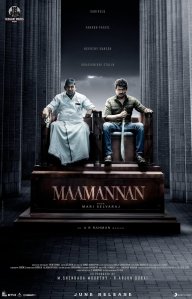
Selvaraj who has also written the story, comes up with a brilliant storyline that revolves around Maamannan who becomes an MLA in the ruling party. The point to note is, though he was an ordinary party worker in the past, he gets a chance to contest when the constituency is declared as a reserved category seat. It is ensured that he is made aware of the fact that he is an MLA only thanks to the largesse of the local dominant community leader who made him contest and backed him to become the MLA. Trouble soon surfaces when Maamannan’s son who is battling his own inner demons of oppression right from childhood, doesn’t want to continue with his dad’s subservient attitude and takes on the dominant community leader. In the ensuing battle which is first fought with physical power and then in the political arena, how Maamannan and his son come out triumphant is the rest of the story.
You should give it to Selvaraj for keeping the narrative impactful and hard-hitting for most parts. Like in Karnan, Selvaraj continues the use of symbols in scene after scene to convey the discrimination that prevails in society. Ratnavelu, his dad and many of his acolytes who belong to upper caste leaders are always dressed in whites while Maamannan as a party worker wears a black shirt and coloured lungis. Their pets are dogs and piglets respectively. While you find the walls of Ratnavelu’s house adorned by portraits of his father, grandfather etc… it is pictures of Periyar and his own mentor in the case of Maamannan. Selvaraj uses every opportunity to drive the point of caste discrimination in the film. While the name of the hero Maamannan actually refers to “Emperor”, he is always referred to as “Mannu” patronisingly which actually means sand and also “good for nothing” by his party bosses.
The film falls into the typical trap of “First Half Vs Second Half” syndrome. After having set the tempo and the context of the story very well in the first half, the film falters a bit in the second half when it comes to the way in which Maamaanan along with his son redeem themselves and their community. It seems as if the director exhausted all his stock in the first half itself as all the high-impact moments are all done and dusted by the time we get to the intermission. The latter half is more cinematic with mass moments and is devoid of the grounded narrative of the first half. The impact quotient which is at an absolute high at the beginning of the film peters down towards the end completely.
Vadivelu, one of the naturally talented comedians of Tamil cinema makes a huge comeback in the title role as Maamannan and gives a performance of his life. His casting is an inspired choice and is a master stroke by Selvaraj. Fahadh Faasil plays the role of Ratnavelu whose characterisation is of a ruthless caste bigot. He plays that role with such venom and rage that some scenes where he is involved in crude violence refuse to go away from your minds hours after the film is over. He cuts his birthday cake with a dagger knife! From Bangalore Days where he played a quiet recluse husband to this, Fahadh’s evolution has been commendable. Udhayanidhi Stalin plays the role of Maamannan’s son who becomes the protagonist eventually. Pitted alongside some gifted performers like Vadivelu and Fahadh, Udhayanidhi’s limitations as an actor comes through starkly. The scope for Keerthy Suresh is limited in this role but she manages to handle the role as competently as possible.
Mari Selvaraj once again demonstrates that he is a filmmaker to watch out for. I liked the way he has staged some of the scenes in this film where he has used the camera angles and shots to convey the simmering and altering power equations between characters. Throughout the film, he brings in the issue of “Chair and seating” to hammer the point of discrimination. Rahman’s music is a huge plus for the film both in terms of songs and background score. Theni Eashwar’s camerawork is also on point.
Selvaraj said during the film’s promotions that the starting point for this film was Kamal Haasan’s film of 1992 – Thevar Magan which centred around caste base violence in rural Tamil Nadu. I found Maamannan far more engaging and rooted than Thevar Magan. Overall, Maamannan is a “Must Watch” film for the subject it deals with and the performances of the lead actors.
 AnandKumarRSonFilms
Leave a comment